How Long Home Appliances and Systems Last: A Lifespan Chart
On this page
Short answer: most of a home's big systems last somewhere between 10 and 30 years. Water heater makers put a tank heater at 8 to 15 years and a tankless one at up to 20. Lennox, Carrier, and Trane put a gas furnace at 15 to 20 years and a heat pump at 10 to 15. GAF puts an asphalt shingle roof at 20 to 30 years, and Zoeller puts a sump pump at 7 to 10. Industry estimates put a dishwasher at about 9 years and a clothes dryer at about 13. Smoke alarms are the one item with a hard deadline: the NFPA says to replace them 10 years after the manufacture date.
Every figure in the chart comes from a named source: the manufacturer where it publishes one, a government agency, the NFPA, or one of the two most widely cited industry estimates, the NAHB/Bank of America study (2007) and InterNACHI's life expectancy chart. Where they disagree, the chart shows each one instead of averaging them. These are typical figures for equipment that gets normal maintenance, not guarantees. A well-kept furnace can outlast its range, and a neglected one can fail early.
Age is for planning, not a reason to panic. Don't replace something that works just because it hit a number; start saving and watching for the signs in the third column. The exceptions are smoke and carbon monoxide alarms, which have replacement dates set by the NFPA and the alarm makers.
The Home Lifespan Chart
| Item | Typical lifespan | Signs it's near the end, or what shortens it | Who says what |
|---|---|---|---|
| Tank water heater (gas or electric) | 6–15 years | Water pooling around the tank body, which Rheem says usually means internal corrosion and replacement; rusty hot water (Bradford White). Sediment and corrosion shorten tank life (A.O. Smith). | A.O. Smith 8–12; Rheem about 10; Bradford White 10–15; DOE 10–15; NAHB (2007) gas 10, electric 11; InterNACHI 6–12 |
| Tankless water heater | 10–20+ years | Temperature swings, banging or popping from mineral buildup, and leaks (A.O. Smith). Hard-water scale is the biggest threat (A.O. Smith). | A.O. Smith 15–20; Bradford White up to 20; DOE more than 20; NAHB (2007) 20+; InterNACHI 10 |
| Gas furnace | 15–30 years | Frequent repairs, rising energy bills, new noises (Lennox). Dirty filters, skipped maintenance, and poor ductwork or venting shorten it (Lennox). | Lennox 15–20; Carrier 15–20, up to 30 with meticulous care; Trane 15–20; NAHB (2007) 18; InterNACHI 15–25 |
| Central air conditioner | 7–20 years | More frequent repairs, higher bills, rooms that won't stay comfortable (Lennox, Trane). Hot, humid climates and a wrongly sized unit shorten it (Lennox). | Lennox 15–20 (12–15 on its heat pump page); Carrier 15–20; Trane 10–12 (about 15 on another Trane page); NAHB (2007) 10–15; InterNACHI 7–15 |
| Heat pump (air-source) | 10–16 years | It heats and cools, so it runs year-round (Lennox, Carrier). Grinding, squealing, or odd smells; Lennox says to start planning once it passes 10 years. | Lennox 10–15; Carrier 10–15; Trane 10–15; NAHB (2007) 16; InterNACHI 10–15 |
| Boiler | 13–40 years | Water quality, maintenance, installation, and system type all affect it (Carrier). Carrier suggests weighing replacement past 15 years if repairs or bills are climbing. | Lennox 15–30; Carrier 15–20; NAHB (2007) gas 21, electric 13; InterNACHI 40 |
| Asphalt shingle roof | 20–30 years | Curled, cupped, or cracked shingles, bald spots where granules are gone, and recurring leaks (Owens Corning, GAF). Poor attic ventilation and hot climates shorten it (Owens Corning, InterNACHI). | GAF 20–30; Owens Corning "two to three decades"; NAHB (2007) 20; InterNACHI 3-tab 20, architectural 30 |
| Metal roof | 40–80 years | Weather, installation, and maintenance all affect roof life (GAF). Hail and hurricanes can shorten any roof (InterNACHI). | GAF 50+; InterNACHI 40–80 |
| Tile roof (clay or concrete) | 50–100+ years | Storm damage to a few tiles needs repair to protect the rest of the roof (InterNACHI). | GAF 50–100; NAHB (2007) "lifetime"; InterNACHI 100+ |
| Slate roof | 50–150 years | Weather, design, material quality, and maintenance set where a roof lands in its range (InterNACHI). | NAHB (2007) 50+; InterNACHI 60–150 |
| Wood shingle or shake roof | 25–30 years | The life of any wood product depends heavily on moisture getting in (InterNACHI). | NAHB (2007) 30; InterNACHI 25 |
| Sump pump | 3–10 years | Won't start when the pit fills, runs nonstop, runs without moving water, is loud, or has rusted parts (Zoeller). | Zoeller 7–10; Wayne about 3 to 6, by model; InterNACHI 7 |
| Refrigerator | 9–13 years | Keep the door seals airtight and, on older models, the coils clean; ENERGY STAR says one over 15 years old could be costing you more to run. | NAHB (2007) 13; InterNACHI 9–13; ENERGY STAR figures its savings over a 12-year life |
| Dishwasher | About 9 years | How often and how it's used, humidity, and routine care decide it; GE Appliances says no lifespan can be predicted, even roughly. | NAHB (2007) 9; InterNACHI 9 |
| Clothes washer | 5–15 years | Overloading stresses it; keep it level and check the hoses for bulging, cracking, and fraying (Whirlpool). | NAHB (2007) 10; InterNACHI 5–15 |
| Clothes dryer | About 13 years | Longer drying times point to a full lint screen or a clogged vent (Whirlpool), which is also a fire risk (USFA). | NAHB (2007) 13, gas or electric; InterNACHI 13 |
| Range or oven | 10–18 years | Makers don't publish a figure: GE Appliances says an appliance's lifespan can't be determined, even approximately. | NAHB (2007) gas range 15, electric 13; InterNACHI gas range 15–17, electric range 13–15, gas oven 10–18 |
| Garbage disposal | About 12 years | Shells, glass, metal, caustic drain cleaners, hot grease, and skipping the cold-water flush after grinding can damage it (InSinkErator). | NAHB (2007) 12; InterNACHI 12 |
| Smoke alarm | Replace at 10 years | Count from the manufacture date on the alarm, and test monthly. Chirping that continues after a new battery means it's at end of life (NFPA). | NFPA, Kidde, and First Alert: replace every 10 years; NAHB (2007) and InterNACHI: under 10 |
| Carbon monoxide alarm | 5–10 years, by model | Replace it as its maker says, and test monthly (NFPA). Kidde: a quick beep every 30 seconds that continues after new batteries means end of life, and the alarm can no longer detect CO. | Kidde 7 or 10, by model; First Alert 5–7; InterNACHI 5 |
| Water softener | 10–20 years | Hard-water signs coming back, like limescale and stains on fixtures (Culligan). Culligan says regular service helps it reach its full life. | Culligan 10–15; InterNACHI 20 |
| Windows | 15–40+ years | Fog between the panes (a failed seal), drafts, and sashes that stick or won't stay open (Andersen). InterNACHI rates double-pane glass itself at 8–20. | InterNACHI vinyl or fiberglass 20–40, wood 30+, aluminum 15–20; NAHB (2007) aluminum 15–20, wood 30+ |
| Deck | 8–30 years | Soft or spongy wood, loose or rusted fasteners, wobbly railings (NADRA). Climate matters: NAHB put wood decks at 10–15 years in the South and 20–30 in the North. | NAHB (2007) wood 20, deck boards 25; InterNACHI wood 10–30, composite 8–25, deck boards 15 |
| Exterior paint | 7–15+ years | Peeling from moisture through worn caulk or leaks (Sherwin-Williams). Sun shortens it; surface prep and paint quality matter most (InterNACHI). | Sherwin-Williams 7–10; InterNACHI 7–10; NAHB (2007) 15+ |
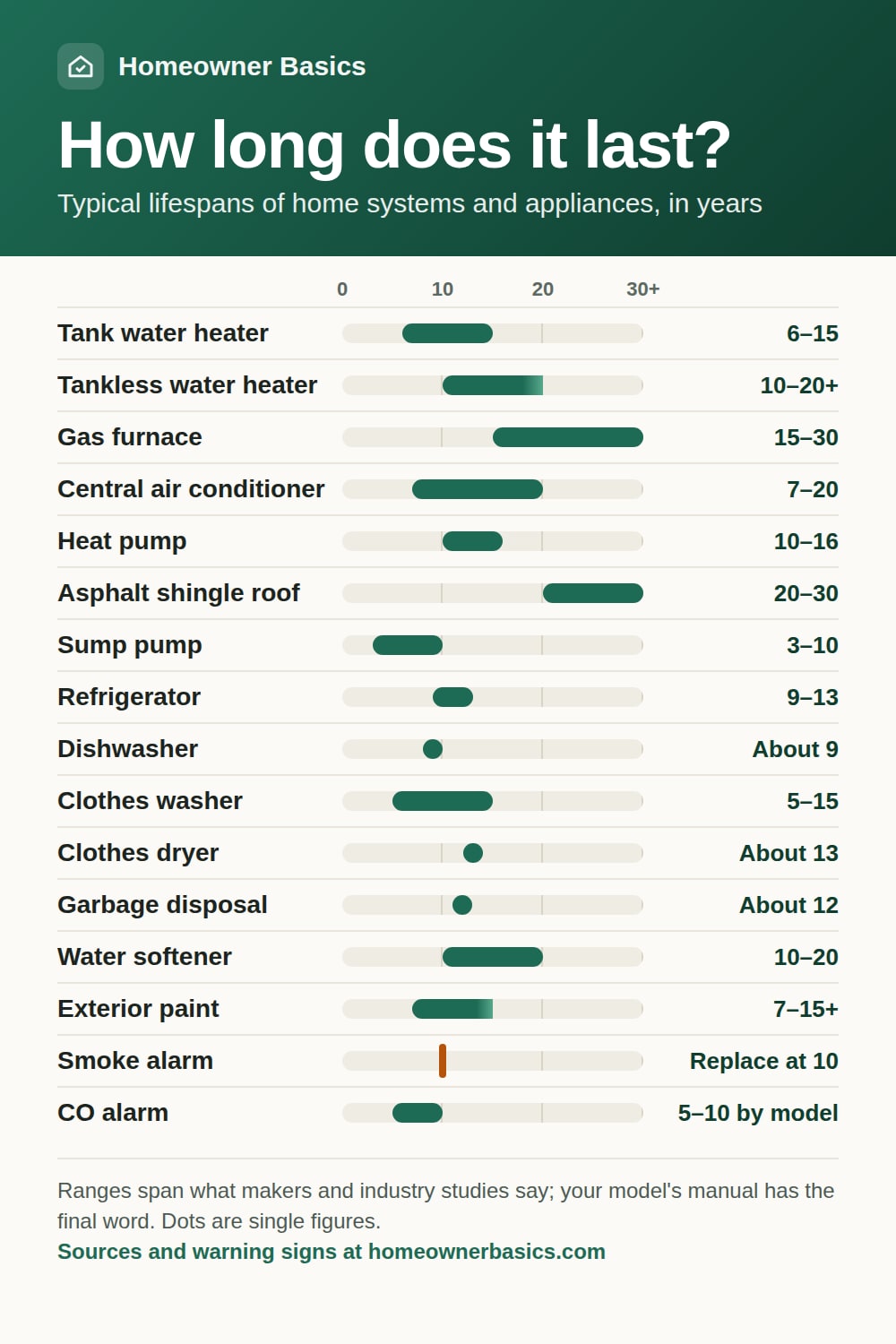
Why the numbers differ. Each source answers a slightly different question. Manufacturers describe their own equipment, with the maintenance they recommend. The NAHB study, published in February 2007, came from a 2006 telephone survey of manufacturers, trade associations, and researchers, and its appliance figures assume use by the first owner. InterNACHI's chart is an online chart that says its figures assume regular recommended maintenance and normal wear, not extreme weather, neglect, or abuse, and should be used as guidelines only. Neither study measured your house, and the NAHB figures are almost two decades old.
Appliance makers mostly don't publish a number. GE Appliances says it is not possible to determine an appliance's lifespan, even an approximate age, because it depends on how often and how it is used, where it sits (high humidity, for example), and routine care. Whirlpool says only that a washer and dryer can last many years with regular maintenance. That is why the appliance rows lean on the two studies.
A warranty is not a lifespan. CertainTeed says a "lifetime" shingle warranty covers you for as long as you own the home, not for the life of the home, and doesn't assume the shingles will last a lifetime. Read any warranty term the same way: it tells you what the maker will cover, not how long the thing will last.
How to Make Each One Last Longer
Most of what pushes a system toward the long end of its range is routine care. Put these on your month-by-month maintenance calendar so they actually happen.
- Tank water heaters. A.O. Smith lists three yearly tasks: inspect the anode rod, flush the sediment, and test the temperature and pressure relief valve. Our guides cover flushing a water heater and checking the anode rod. A tankless heater skips those but needs descaling, especially with hard water.
- Furnaces, air conditioners, and heat pumps. ENERGY STAR says to inspect, clean, or change the air filter once a month, because a dirty filter can damage the equipment and lead to early failure. It also recommends a contractor check-up before each season, cooling in spring and heating in fall, since dirty coils, the wrong refrigerant charge, and faulty electrical connections all shorten equipment life. See how to change a furnace filter.
- Roofs. Watch for missing shingles, moss, and granules in the gutters or on the ground, and check the attic for signs of leaks, as GAF suggests. Owens Corning notes that a poorly ventilated attic ages shingles faster.
- Sump pumps. Pour water into the pit and make sure the pump starts on its own and drains it, as Zoeller and Wayne both describe. Wayne's manual calls for an inspection 3 to 4 times a year. Our sump pump test walks through it.
- Smoke and CO alarms. Test them monthly, as the NFPA advises, and replace them by date rather than waiting for a failure. See how to test smoke alarms.
- Washers and dryers. Don't overload either one, keep both level, and check the washer hoses, as Whirlpool advises. The U.S. Fire Administration says to clean the dryer's lint filter before and after each cycle, and a clogged vent both slows drying and raises fire risk: how to clean a dryer vent.
- Garbage disposals. InSinkErator says to run cold water before, during, and for several seconds after grinding, and to keep grease out of it and every other drain.
- Decks and paint. Go over the deck once a year with NADRA's checklist, and recoat it when the finish wears away. Before repainting, replace worn caulk and fix leaks, the moisture sources Sherwin-Williams links to peeling.
Budgeting for Replacements
The chart's real job is planning. Our home maintenance budget guide covers how much to set aside each year. Here is how to point that money at the right replacement first.
- Find out how old everything is. The manufacture date is usually coded into the serial number on the label or rating plate. On a Bradford White water heater, the first two characters of the serial number give the year and month; on a GE appliance, the first two letters do. Smoke and CO alarms have the date printed on them. Your home inspection report may note the ages of the roof and major systems too.
- Line each item up against the low end of its range. Anything that is already there, or will be within a few years, goes to the top of the list. Rheem recommends planning a tank water heater replacement around year 10. Carrier suggests considering replacement when an air conditioner or heat pump is more than 10 years old or a furnace or boiler is more than 15, particularly if it needs frequent repairs or the energy bills are rising. ENERGY STAR says to have heating and cooling equipment more than 10 years old evaluated by a professional.
- Give the big items their own savings lines. The roof, the heating and cooling system, and the water heater each get a target year, so the reserve fund grows toward the nearest one.
- Replace on your schedule, not the emergency's. A replacement you planned leaves time to compare options and quotes. One forced by a burst tank or a dead furnace in January doesn't.
Frequently Asked Questions
What lasts the longest in a house?
On this chart, roof coverings made of slate and tile. InterNACHI puts slate at 60 to 150 years and clay or concrete tile at 100 or more, and the NAHB study calls clay and concrete roofs a lifetime material. Among mechanical systems, boilers have the widest spread: InterNACHI says 40 years, Lennox 15 to 30, and Carrier 15 to 20. At the other end, sump pumps and carbon monoxide alarms have some of the shortest lives on the chart.
Should I replace something just because it is old?
Not if it works and shows none of the warning signs, with two exceptions: smoke alarms and CO alarms go by their replacement dates no matter how they seem to work. For everything else, age tells you when to start saving and when to get an opinion. A water heater past 10 years, or a furnace past 15 that keeps needing repairs, is worth a professional's look; our DIY vs. hire a pro guide helps sort out which jobs need one.
Will a "30-year" or "lifetime" shingle roof last that long?
Don't count on it. The warranty term describes coverage, not lifespan. CertainTeed says a lifetime warranty runs for as long as you own the home and doesn't assume the shingles will last a lifetime. GAF says asphalt shingles generally last 20 to 30 years, and Owens Corning lists a roof at least 20 years old, or one that looks worn, as a sign it may need replacing.
How often do smoke and CO alarms need replacing?
Smoke alarms: 10 years after the manufacture date, per the NFPA, Kidde, and First Alert. CO alarms: whatever the maker says, which the NFPA tells you to follow. Kidde gives its CO alarms a 7- or 10-year life depending on the model, and First Alert says to replace CO detectors every 5 to 7 years. Test both kinds monthly. An alarm in end-of-life mode needs replacing right away: Kidde says a CO alarm in that mode can no longer detect carbon monoxide.
The Bottom Line
Going by the makers' own figures, a tank water heater lasts about 8 to 15 years, a gas furnace 15 to 20, a heat pump 10 to 15, an asphalt shingle roof 20 to 30, and a sump pump 3 to 10. For central air, Carrier says 15 to 20 years and Lennox 12 to 20 depending on the page, while Trane and the studies say less. Industry estimates put most major appliances at about 9 to 13 years, with gas ranges a little longer. Treat those ranges as planning dates, not deadlines: find out how old each item is, save toward whichever is closest to the low end of its range, and do the routine care that pushes it toward the long end. Smoke and CO alarms are the exception: replace them on their dates, every time.
Sources
- A.O. Smith — how long do water heaters last (tank heaters 8 to 12 years; tankless 15 to 20; tankless units avoid the sediment buildup and corrosion that shorten tank lifespans; hard-water mineral buildup is the biggest threat to tankless units; warning signs include inconsistent temperature, banging, rumbling, or popping, and leaks) and water heater maintenance checklist (yearly anode rod inspection, sediment flush, and relief valve test for tank heaters; descaling for tankless; rust-colored water can mean a used-up anode and a failing tank).
- Rheem — 5 signs your water heater is going bad (most conventional tank heaters last around 10 years; plan replacement around year 10; moisture around the tank body typically signals internal corrosion and the need for replacement).
- Bradford White — 10 key things to know about water heaters (gas and electric heaters around 10 to 15 years; tankless up to 20), what is the average lifespan of a water heater? (consider replacement at 10 years or older; rusty water; leaks around the base), and determining the age of a water heater (the first two characters of the serial number give the year and month of manufacture).
- U.S. Department of Energy, Energy Saver — tankless or demand-type water heaters (most tankless heaters have a life expectancy of more than 20 years; storage water heaters last 10 to 15 years). Archived copy from June 2026; the live energy.gov page now returns "not found."
- Lennox — how long does a furnace last (gas furnaces 15 to 20 years; boilers 15 to 30; frequent repairs, rising energy bills, and strange noises; dirty filters, ductwork, and venting affect lifespan), how long do air conditioners last (central air 15 to 20 years; frequent repairs and higher bills; hot, humid climates and wrong sizing shorten life), and how long do heat pumps last (10 to 15 years; heat pumps work year-round; grinding, squealing, or banging and odd smells; start planning once a heat pump passes 10 years).
- Carrier — how long do HVAC systems last? (furnace 15 to 20 years, air conditioner 15 to 20, heat pump 10 to 15, boiler 15 to 20; boiler life depends on water quality, maintenance, installation, and system type; consider replacing an air conditioner or heat pump past 10 years or a furnace or boiler past 15, particularly with frequent repairs or rising bills) and how long does a furnace last? (15 to 20 years; up to 30 if properly installed and meticulously maintained).
- Trane — 6 warning signs that it's time to replace your HVAC (an air conditioner or heat pump 10 to 12 years, a furnace 15 to 20; more frequent repairs, rising bills, odd noises or odors, and inconsistent temperatures), how long do heat pumps last? (10 to 15 years), and top home heating and cooling questions (central air conditioners about 15 years).
- ENERGY STAR — heat and cool efficiently (have equipment more than 10 years old, or that isn't keeping the house comfortable, evaluated by a professional), maintenance checklist (inspect, clean, or change filters once a month; a dirty filter can lead to early failure; pre-season check-ups, cooling in spring and heating in fall; dirty coils, incorrect refrigerant charge, and faulty electrical connections reduce equipment life), and refrigerators (savings figured over a 12-year product lifetime; refrigerators over 15 years old cost more to run; airtight door seals; clean coils on older models).
- GAF — residential roofing FAQs (asphalt shingles generally 20 to 30 years, metal 50 or more, tile 50 to 100; weather, installation, and maintenance affect lifespan; missing, curling, or cracked shingles, excessive granule loss, and recurring leaks; consult a roofer about a roof more than 20 years old).
- Owens Corning — 7 signs you may need a new roof (curled or cupped shingles, bald spots, cracked shingles, a roof at least 20 years old or that looks worn; poor ventilation hurts shingles) and 3 signs it's time to replace your roof (high-quality asphalt shingles can provide two to three decades of protection).
- CertainTeed — understanding roof warranties (a lifetime warranty covers you for as long as you own the home, not the life of the home, and doesn't assume the shingles will last a lifetime) and roofing 101: warranties (shingle warranties from 20 years to lifetime-limited).
- Zoeller — frequently asked questions (7 to 10 years on average with proper installation and maintenance; test by pouring water into the pit) and when to replace a sump pump (failure to operate, continuous operation, excessive noise, running without discharging water, damp basement, rust).
- Wayne — submersible sump pump installation manual (PDF, archived copy) (approximately 3 years of service for models with a 1- or 2-year warranty and 6 years for models with a 3- or 5-year warranty; inspect 3 to 4 times a year; pour a bucket of water into the pit to check that it starts; replace the tether switch every two years).
- NFPA — smoke alarms (replace all smoke alarms 10 years after the manufacturing date; test at least once a month; chirping that continues after a new battery means end of life) and carbon monoxide safety (test CO alarms at least once a month and replace them according to the manufacturer's instructions).
- Kidde — when should I replace my alarms? (smoke and heat alarms every 10 years; CO and combination alarms every 7 to 10, depending on the model), CO detector replacement FAQs (7- or 10-year lifespan), and when should I replace my CO alarm? (a quick beep every 30 seconds with a flashing red light that continues after new batteries means end of life; an alarm in end-of-life mode cannot detect CO).
- First Alert — what is a 10-year sealed battery smoke detector? (replace smoke detectors at least every 10 years) and things to know about carbon monoxide alarms (replace every 5 to 7 years; test monthly).
- GE Appliances — appliance life span (it is not possible to determine an appliance's lifespan, even an approximate age; frequency and type of use, location such as high humidity, routine care, and maintenance) and how to determine the age or manufacture date (the first two letters of the serial number give the month and year).
- Whirlpool — washer and dryer maintenance tips (no year figure: a washer and dryer can last many years with care; overloading stresses the washer; keep both level; inspect hoses for bulging, cracking, and fraying; a full lint trap and dirty vents lengthen drying times).
- InSinkErator — Badger series installation, care, and use manual (PDF) (no clam or oyster shells, caustic drain cleaners, glass, metal, or hot grease; cold water before, during, and after grinding; failure to flush may damage the disposer; keep grease out of all drains).
- U.S. Fire Administration — clothes dryer fire safety (PDF) (higher fire risk if the lint filter and vents aren't cleaned; clean the lint filter before and after each cycle).
- Culligan — water care FAQs (softeners last 10 to 15 years on average; regular servicing helps them reach their maximum lifespan) and 5 signs you need a water softener (stains and limescale from hard water).
- Andersen — 6 signs it's time to replace your windows (hard to open or won't stay open, drafts, cloudy or foggy glass from a failed seal) and condensation on windows (condensation between the panes means the seal has failed).
- North American Deck and Railing Association — Check Your Deck consumer checklist (PDF) (split or decaying wood, soft and spongy wood, loose or corroded fasteners, railings, flashing; recoat when the coating has worn away).
- Sherwin-Williams — how to paint a house exterior (exterior paint may last 7 to 10 years depending on climate, surface, and paint quality) and peeling (moisture through uncaulked joints or worn caulk, roof or wall leaks).
- National Association of Home Builders and Bank of America Home Equity — Study of Life Expectancy of Home Components (PDF, February 2007, archived copy) (telephone survey of manufacturers, trade associations, and researchers in summer 2006; appliance figures assume first-owner use; all NAHB figures in the chart).
- InterNACHI — Standard Estimated Life Expectancy Chart for Homes (undated online chart, consulted October 2026; figures assume regular recommended maintenance and normal wear and are guidelines only; hot climates drastically reduce asphalt shingle life; severe weather can shorten any roof; all InterNACHI figures in the chart).
Last reviewed October 3, 2026. General information, not professional advice: lifespans are published estimates, not guarantees, and a licensed contractor should judge the condition of your own equipment.